
Jaisalmer: The Golden City Built on a Trade-Route Legend
Jaisalmer Fort was founded on the advice of a hermit's prophecy in 1156 CE and grew rich as a Silk Route tollgate — the Bhati Rajput history and desert legends behind Rajasthan's Golden City.
Jaipur gets the crowds, Udaipur gets the honeymoon photography, but Jaisalmer — rising directly out of the Thar Desert in golden sandstone — has a foundation story and a trade history that neither of the other two can match.
History
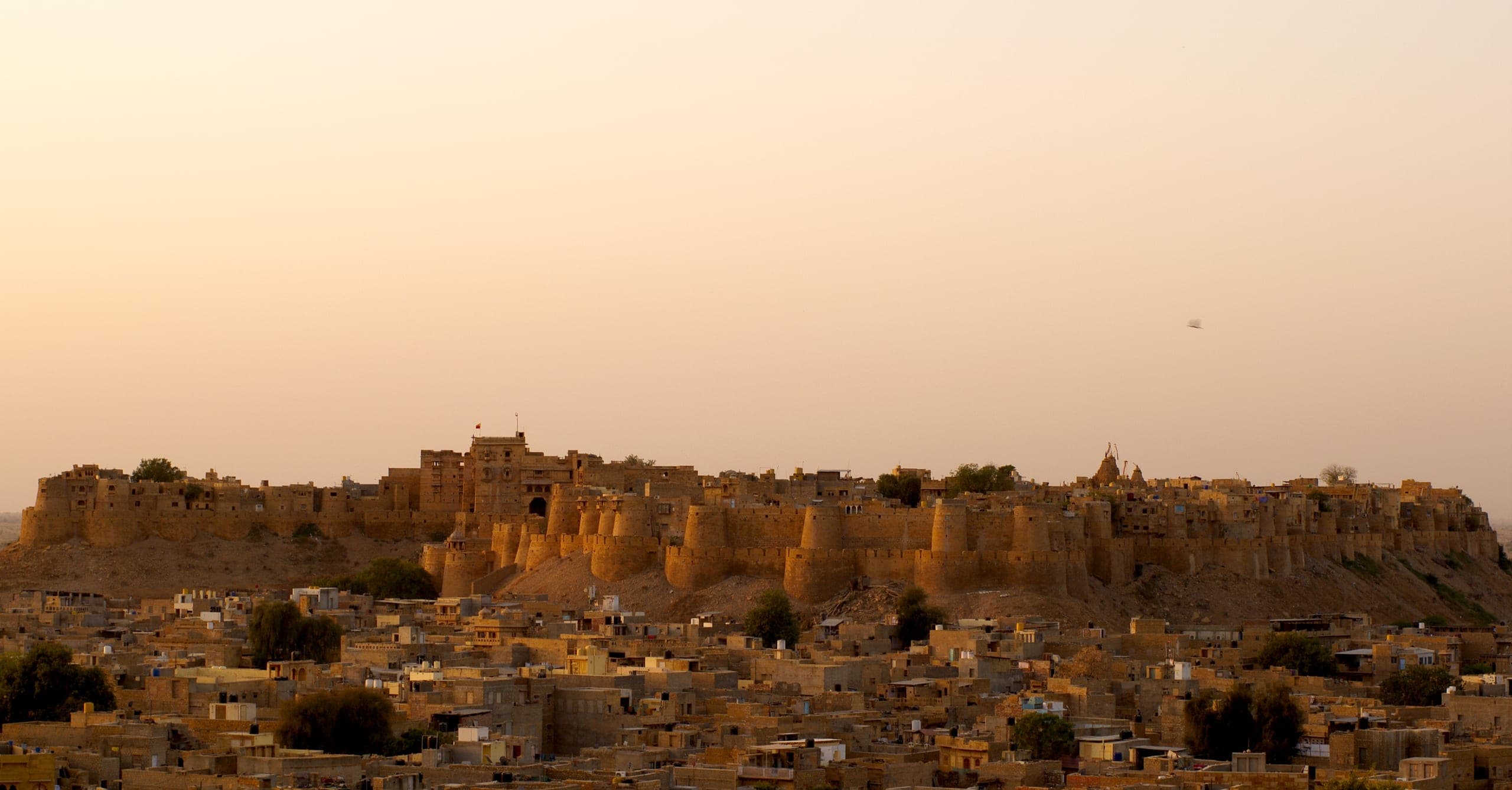
Jaisalmer Fort was founded in 1156 CE by Rawal Jaisal, a Bhati Rajput ruler, on the advice of a local hermit who is said to have prophesied that this specific hilltop — Trikuta Hill — was destined to host a great and enduring kingdom. Whatever the truth of the prophecy, the location turned out to be a genuinely shrewd strategic choice: Jaisalmer sat directly along the trade routes connecting India to Central Asia, Persia, and Egypt, and for several centuries the Bhati rulers grew wealthy primarily by taxing the camel caravans that passed through — a tollgate kingdom in the middle of the Thar Desert, built on customs revenue from goods moving along a branch of the Silk Route rather than on agriculture, which the surrounding desert made largely impossible.
That trade-route wealth is why Jaisalmer's havelis — the ornately carved merchant mansions scattered through the old city — are as architecturally significant as the fort itself; families who grew rich on caravan trade competed with each other through increasingly elaborate stone latticework (jharokhas) on their houses, a competitive architecture unique to this specific kind of desert trading wealth.
Legend & the "Living Fort"
Jaisalmer Fort is one of the very few "living forts" in the world — meaning roughly a quarter of the old city's population still resides within the fort walls today, running shops, guesthouses, and homes inside a structure most comparably ancient forts elsewhere have long since emptied into museums. That continuity is part of why UNESCO inscribed it as a World Heritage Site in 2013, as part of a broader listing of Rajasthan's hill forts.
Local legend holds that Jaisalmer's decline as a trading power — after the rise of sea trade routes and the British port at Bombay reduced overland caravan traffic in the colonial period — was itself foretold by the same hermit whose advice founded the city, a symmetry local guides are fond of pointing out even though it's almost certainly a later embellishment onto the original founding myth.
Beyond the fort, the Thar Desert itself carries its own layer of legend and living culture — Rajasthani folk traditions of desert spirits, the Manganiyar and Langa musical communities whose ballads have been passed down for generations, and the Sam Sand Dunes, where camel safaris now recreate, in miniature and for tourists, journeys that caravans once made for trade rather than sightseeing.
The Jauhar and Saka Legends
Jaisalmer's Rajput history includes some of Rajasthan's most somber wartime traditions — the fort withstood multiple sieges over the centuries, and local memory holds accounts of jauhar (self-immolation by royal women to avoid capture) and saka (a final, deliberate last stand by the fort's defenders) during at least two major sieges, most notably associated with conflicts against the Delhi Sultanate in the 14th century. These accounts, common across Rajput fort histories, form part of why Jaisalmer's fort carries a weight beyond its architecture — it's remembered locally as much for what was defended and lost here as for what was built.
The desert surrounding Jaisalmer also holds the abandoned village of Kuldhara, said to have been deserted overnight by its entire Paliwal Brahmin population in the 19th century rather than submit to a local official's demands — a story now wrapped in ghost-town legend, drawing a steady trickle of visitors more interested in the mystery than the fort itself.
Quick Facts
- 1156 CE, by Rawal Jaisal of the Bhati Rajput dynasty
- World Heritage Site since 2013 (Hill Forts of Rajasthan)
- One of the world's few "living forts" — still inhabited by roughly a quarter of the old city's population
- Built on taxing Silk Route caravan trade, not agriculture
- Merchant havelis with elaborately carved jharokha stonework
- October–March
Getting There
Jaisalmer has its own airport with seasonal connections, and a railway station connected to Jaipur, Jodhpur, and Delhi — most visitors arrive via an overland Rajasthan circuit rather than flying in directly.
Our Land of Kings trip covers Jaipur, Jaisalmer, Jodhpur, and Udaipur in one route, including Jaisalmer Fort, its havelis, and a camel safari with a desert sunset at the Sam Sand Dunes.
Photo: This Photo was taken by Timothy A. Gonsalves. Feel free to use my photos, but please mention me as the author. I would much appreciate if you send me an email tagooty@yahoo.com or write on my talk page, for my information. Please contact me before commercial use. Please do not upload an edited image here without consulting me. I would like to make corrections only at my own source to ensure that the changes improve the image and are preserved.Otherwise you may upload an edited image with a new name. Please use one of the templates derivative or extract. / CC BY-SA 4.0