
Omkareshwar: The Island Shaped Like Om, Home to One of Shiva's 12 Jyotirlingas
Omkareshwar sits on a Narmada river island naturally shaped like the sacred Om symbol, home to one of the twelve Jyotirlingas — the Mandhata legend and full temple history explained.
There are twelve Jyotirlingas recognized across India as the most sacred category of Shiva shrine, and most require serious travel to reach — Kedarnath in the high Himalayas, Rameswaram at the southern tip of the country. Omkareshwar, sitting on a small island in the Narmada river in Madhya Pradesh, is comparatively accessible — and its island is naturally shaped like the sacred syllable Om, which is either an extraordinary geological coincidence or, depending on who you ask, not a coincidence at all.
History
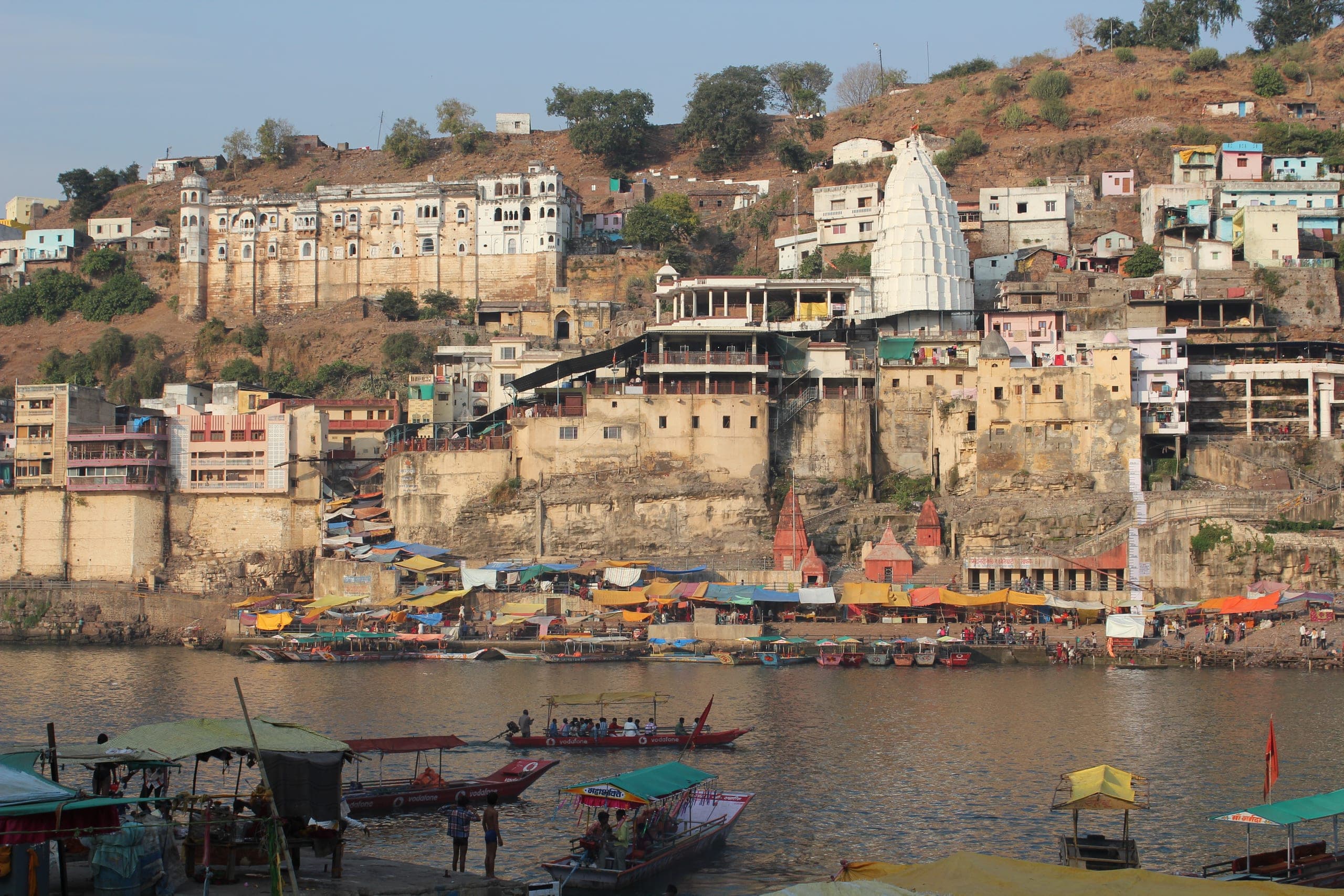
The Omkareshwar temple's documented history stretches back well over a thousand years, with the current structure showing architectural layers from multiple periods, though its status as a Jyotirlinga site is attested in Puranic literature considerably older than any standing structure. The temple sits on Mandhata (also called Shivapuri) island, formed by the Narmada river splitting around it — the island's shape, resembling the Om symbol when viewed from above, has made it a site of natural as well as constructed sanctity for pilgrims long before satellite imagery could confirm the resemblance from the air.
The Narmada river itself holds an unusually elevated status in Hindu geography: unlike most sacred rivers, which pilgrims bathe in or drink from, the Narmada is circumambulated — the Narmada Parikrama, a pilgrimage tradition involving walking the entire length of the river and back, a journey traditionally taking upward of three years on foot, considered one of the most rigorous pilgrimage practices in the entire Hindu tradition.
Mythology & Legend
The island's alternate name, Mandhata, refers to a legendary king, Mandhata, said to have performed intense penance here to please Shiva — with the temple's founding myth crediting his devotion as the reason Shiva chose to manifest permanently at this spot as one of the twelve Jyotirlingas. A parallel, equally significant temple — Amareshwar, on the mainland bank facing the island — is regarded by some traditions as the "true" Jyotirlinga site, with Omkareshwar and Amareshwar together sometimes counted as jointly fulfilling the Jyotirlinga status, a rare case of ambiguity between two sites that most other Jyotirlinga locations don't share.
A widely repeated local legend holds that even Shiva's consort Parvati is said to have worshipped at this site in one Puranic account — an unusual detail, since most Jyotirlinga myths center on sages, kings, or demons rather than other deities, and it's often cited by local priests as evidence of the site's exceptional sanctity even within the already-elite category of Jyotirlingas.
The 68 Tirthas and Ancient Temples on the Island
Beyond the main Jyotirlinga shrine, Mandhata island is dotted with dozens of smaller temples and sacred bathing spots — tradition counts 68 tirthas (sacred sites) across the island, reflecting centuries of accumulated devotional building rather than a single planned complex. Many of these smaller shrines, particularly those built in the Nagara style by regional dynasties across the medieval period, are architecturally significant in their own right even though they sit in the shadow of the main Jyotirlinga temple's fame.
The island is connected to the mainland by both a road bridge and a pedestrian suspension bridge, and pilgrims traditionally complete a parikrama (circumambulation) of the entire island on foot — a shorter, more manageable echo of the much longer Narmada Parikrama tradition the river is famous for.
Quick Facts
- One of the twelve Jyotirlingas — the most sacred Shiva shrine category
- Mandhata Island, on the Narmada river, Madhya Pradesh
- The island's shape resembles the Om symbol from above
- Named for King Mandhata, whose penance is credited with the Jyotirlinga's manifestation
- The Narmada Parikrama — circumambulating the entire river, traditionally on foot
- October–March
Getting There
Omkareshwar is roughly 80 km from Indore, the nearest major city and airport, making it an easy day's reach as part of a wider Madhya Pradesh pilgrimage circuit through Ujjain and Maheshwar.
Our Divine Darshan trip covers Ujjain's Mahakaleshwar Jyotirlinga, Omkareshwar's temple and island, and the riverside heritage town of Maheshwar in one route from Indore.
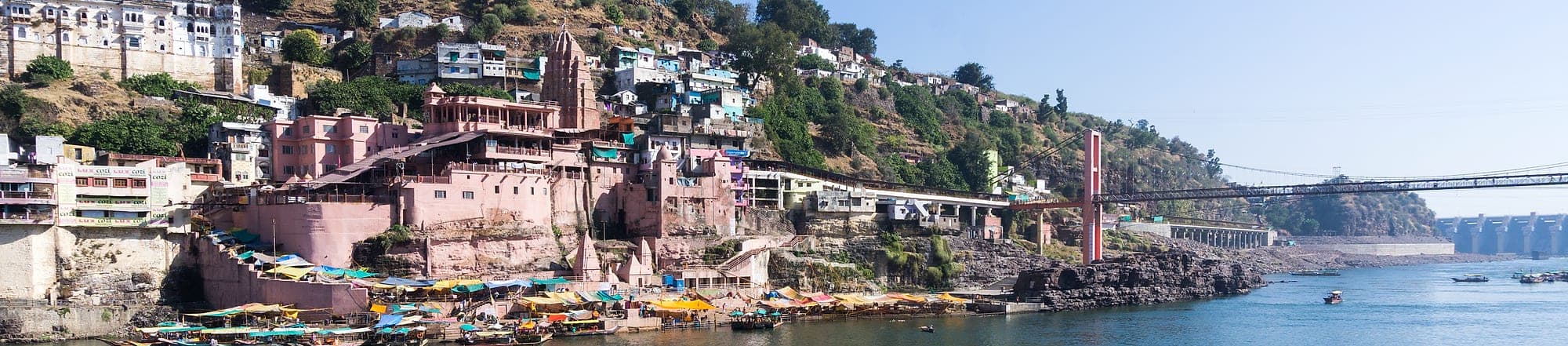
Photo: Sumit Surai / CC BY-SA 4.0