Varanasi: Inside the Mythology of the World's Oldest Living City
Varanasi is one of the world's oldest continuously inhabited cities, believed to be Shiva's own city — the Kashi Vishwanath legend, Manikarnika Ghat's cremation mythology, and the Ganga Aarti tradition explained.
Varanasi is routinely cited as one of the oldest continuously inhabited cities on earth, with settlement estimates ranging from 3,000 years by conservative archaeological dating to considerably older by local tradition. Mark Twain, visiting in the 1890s, wrote that the city was "older than history, older than tradition, older even than legend, and looks twice as old as all of them put together" — and the mythology that's grown up around it over those millennia is dense even by Hindu pilgrimage-city standards.
History
The city's documented history stretches back to at least the time of the Buddha, who delivered his first sermon at nearby Sarnath around the 5th century BCE — meaning Varanasi was already established enough to be a meaningful backdrop to that moment. It has functioned as a center of Hindu learning, Sanskrit scholarship, and classical music and art for most of the intervening centuries, surviving multiple political regime changes — Mauryan, Gupta, Delhi Sultanate, Mughal, and British rule — while retaining its religious centrality throughout. Aurangzeb's demolition of an earlier version of the Kashi Vishwanath Temple in 1669 and its later reconstruction under Ahilyabai Holkar of Indore in 1780 is one of the more consequential episodes in that long history — the current temple's silver-plated domes were added later still, under Maharaja Ranjit Singh in the 19th century.
Mythology & Legend
Varanasi's older name, Kashi ("the luminous one"), reflects its central mythological claim: this is held to be Shiva's own city, the place he chose to reside permanently rather than merely visit, and the Kashi Vishwanath Temple enshrines one of the twelve Jyotirlingas — the most sacred category of Shiva shrine in the Puranic tradition. Hindu belief holds that dying in Kashi grants moksha, liberation from the cycle of rebirth, directly — which is why Manikarnika Ghat, the city's primary cremation ground, is treated not as a site of mourning in the conventional sense but as a place of active spiritual opportunity, cremations conducted in the open, around the clock, for well over a thousand years without interruption according to local tradition.
Manikarnika's own name carries a myth: according to legend, this is where an earring (manikarnika) belonging to Sati, Shiva's first consort, fell during Shiva's grief-stricken wandering with her body after her death — one of several such sites scattered across the subcontinent (the Shakti Peethas) marking where parts of Sati's body or ornaments are said to have landed.
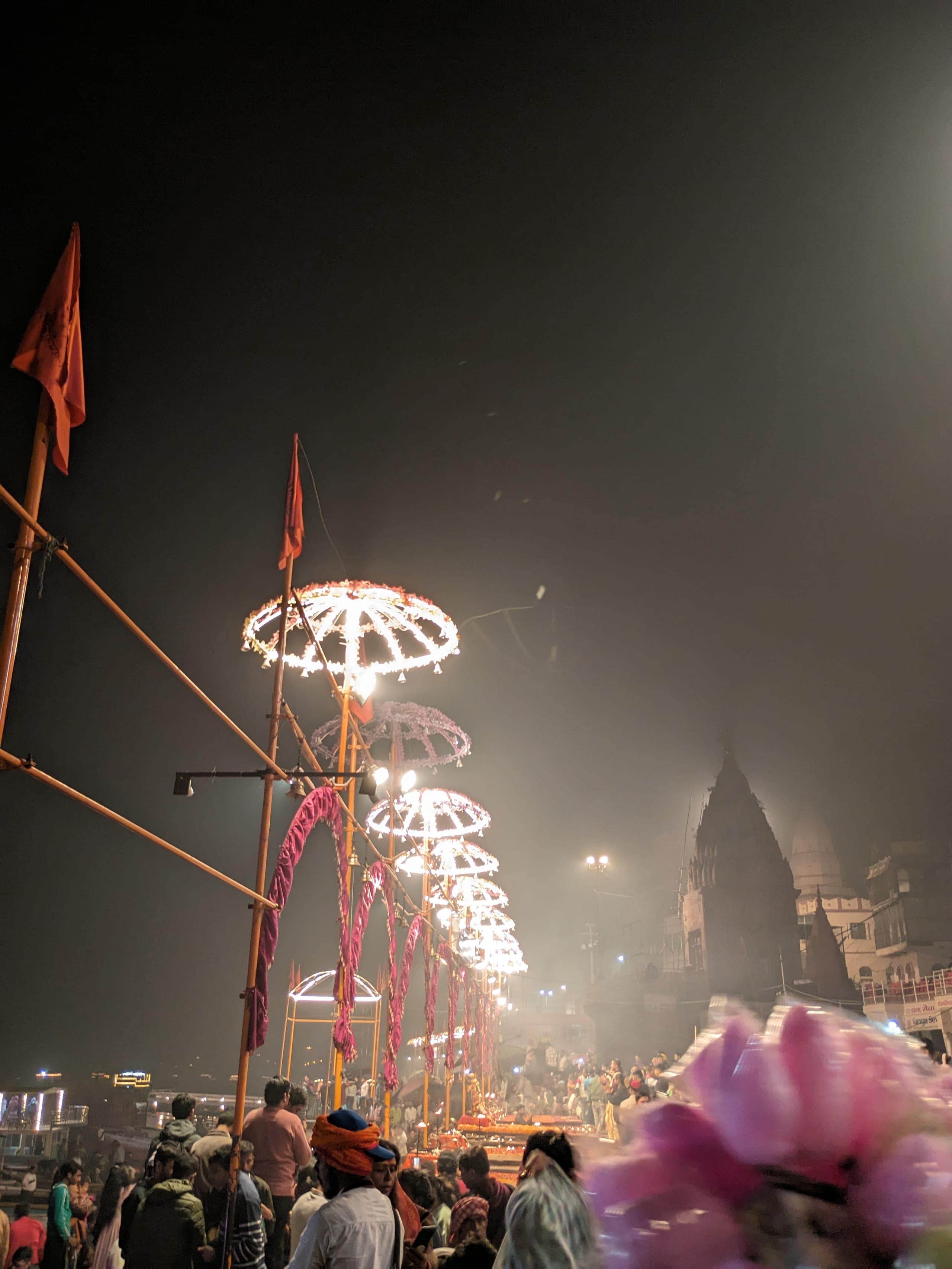
Every evening at Dashashwamedh Ghat, the Ganga Aarti — a synchronized fire ritual performed by a row of priests with multi-tiered brass lamps — draws crowds that rival any performance in the city, a tradition understood to have developed into its current large-scale form only in recent decades, even though river-worship rituals along these ghats go back far longer.
Learning and Music in Kashi
Beyond its religious weight, Varanasi has functioned for centuries as a center of Sanskrit scholarship and classical Indian music, home to Banaras Hindu University (founded 1916) and to the Banaras gharana, a distinct classical music and tabla tradition that produced some of India's most significant musicians, including sitar legend Ravi Shankar and shehnai player Bismillah Khan, whose daily shehnai recitals at Balaji Temple were, for decades, treated by residents as something close to a civic ritual in their own right.
The city's silk-weaving tradition — Banarasi sarees, woven with gold and silver thread (zari) in techniques passed down through generations of largely Muslim weaving families — represents another layer of Varanasi's identity that exists somewhat apart from its Hindu pilgrimage economy, a reminder that the city's cultural weight was never built on religion alone.
Quick Facts
- Among the world's oldest continuously inhabited cities, settlement estimates 3,000+ years
- Home to Kashi Vishwanath, one of the twelve Jyotirlingas
- Dying in Varanasi is held to grant moksha (liberation from rebirth)
- Primary cremation ghat, cremations conducted continuously for centuries
- Site of the Buddha's first sermon, ~5th century BCE
- October–March
Getting There
Varanasi has its own airport and major railway junction, well-connected to Delhi and other major cities, and is commonly combined with Ayodhya, Vrindavan, and Mathura on a single North Indian pilgrimage circuit.
Our Spiritual Heartland trip covers all four: Krishna temples in Vrindavan and Mathura, the full ghat circuit and evening Ganga Aarti in Varanasi, and Ayodhya's Ram Janmabhoomi complex — with a stop in Lucknow on the return leg.
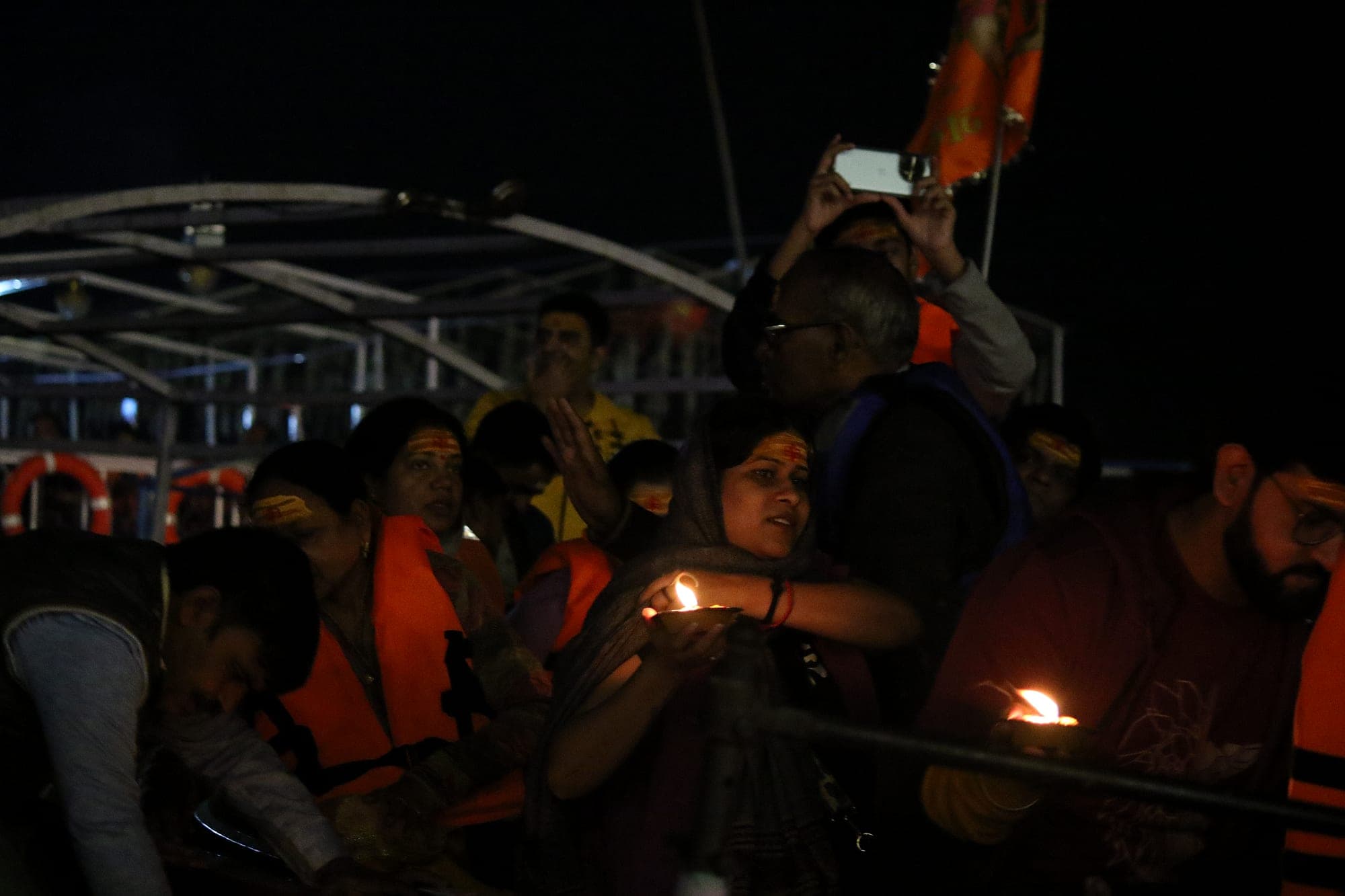
Photo: Goutam1962 / CC BY-SA 4.0