Gokarna Over Goa: Karnataka's Quiet Beach Alternative
Gokarna's Mahabaleshwar Temple holds the Atmalinga Ravana legend — one of Hinduism's oldest myths — behind a beach-hopping trail that still sees a fraction of Goa's crowds.
Goa is the reflexive answer to "let's do a beach weekend from Bangalore." Gokarna, a similar distance down the Karnataka coast, is the answer for people who've already done Goa — and its temple town identity comes with one of the older, stranger myths in the Shiva canon.
History
Gokarna's name — meaning "cow's ear" in Sanskrit — refers to the shape of the local landmass at the confluence of two rivers meeting the sea, and the town has been a pilgrimage site for well over a thousand years, long predating any tourist trail. It sits within the Uttara Kannada coastal belt that historically fell under a succession of regional powers, including the Vijayanagara Empire and later Keladi Nayakas, all of whom patronized the temple in various ways, which is part of why Gokarna's temple complex carries architectural layers from multiple periods rather than a single construction date.
Mythology & Legend
The Mahabaleshwar Temple here is built around one of Shaivism's most specific and dramatic myths: the story of the Atmalinga. According to the Puranas, the demon-king Ravana performed severe penance to please Shiva and was granted the Atmalinga — a lingam so sacred that whoever possessed it would become invincible, on the condition that it never touch the ground before reaching its destination. As Ravana carried it toward Lanka, the gods, alarmed at the power this would give him, sent Ganesha to intervene. Ganesha, disguised as a boy, offered to hold the lingam while Ravana attended to an urgent call of nature — and then deliberately set it down. By the time Ravana returned, the lingam had fused into the earth at Gokarna and could not be moved.
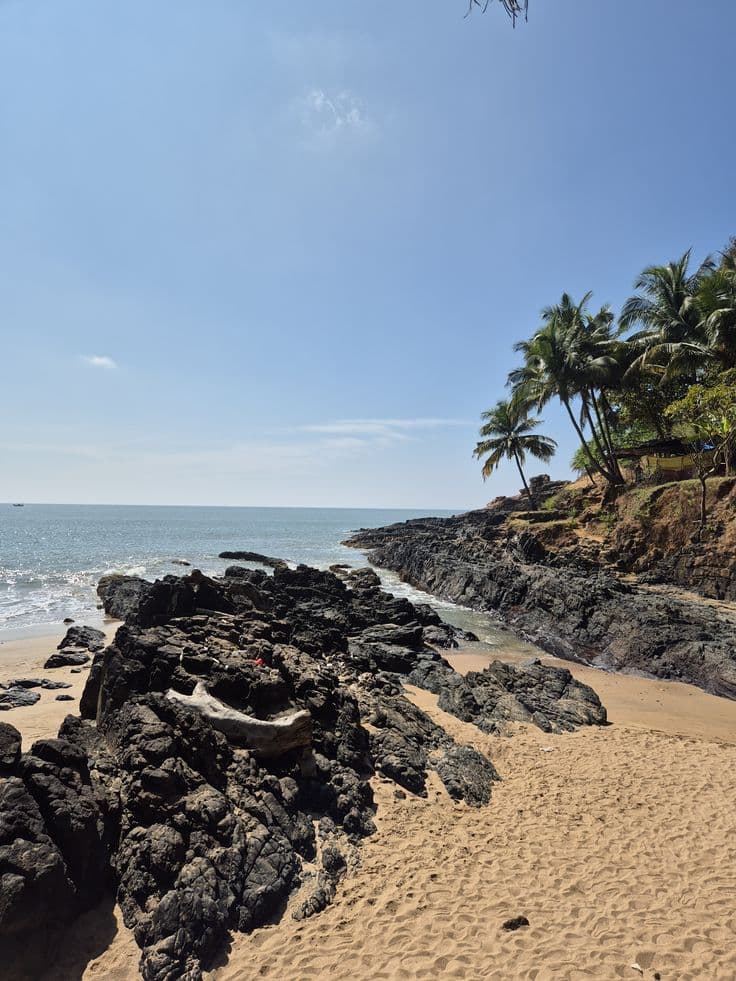
Furious, Ravana is said to have tried to pry the lingam loose, tearing at its casing — an act local tradition points to as the origin of Gokarna's unusual rock formations along the coast, said to be fragments of the casing Ravana flung aside in rage.
The Atmalinga is now enshrined at the Mahabaleshwar Temple and considered one of the most sacred Shiva sites on India's western coast — a claim to religious significance that predates Gokarna's beach-town reputation by many centuries.
The Temple Town Rhythm
Gokarna's daily rhythm still runs on temple time in a way Goa's never did — the Mahabaleshwar Temple's morning and evening rituals draw a steady stream of pilgrims through the old town's narrow lanes, alongside (rather than replaced by) the backpackers heading toward the beaches. Brahmin families have lived in and around the temple complex for generations, and much of the old town's architecture — tiled-roof houses, a temple tank for ritual bathing — reflects that older identity more than it does the beach-tourism economy that's grown up around it more recently.
That dual identity means Gokarna asks a bit more of visitors than Goa does: modest dress is expected near the temple even if beachwear is normal a few hundred metres away, a distinction worth knowing before you arrive.
Quick Facts
- Cow's ear — describing the shape of land at the river-sea confluence
- The Atmalinga myth involving Ravana, Shiva, and Ganesha's trick
- Kudle, Om Beach, Half Moon, Paradise Beach
- Named for its natural Om-symbol shape, visible from above
- One of the most significant Shiva pilgrimage sites on India's west coast
- October–March
Getting There
Gokarna is roughly 480 km from Bangalore by road, or reachable via the Konkan Railway to nearby Ankola or Gokarna Road station. The beach trail itself — Kudle to Om Beach to Half Moon to Paradise Beach — is walkable along coastal cliff paths, with each beach further along seeing progressively fewer people.
We run Gokarna as a weekend trip from Bangalore, trekking the full beach chain and visiting the Mahabaleshwar Temple, then continuing up the coast to Murudeshwar's giant Shiva statue and Honnavar's backwaters — so the trip covers both the myth and the modern beach-hopping reputation in one loop.