Photo: Kondephy / CC BY-SA 3.0
Kullu Dussehra
A week-long Dussehra that starts when everyone else's ends — hundreds of local deities carried down from mountain villages to gather in one valley.
Most of India wraps up Dussehra in a day, burning effigies of Ravana as the finale. Kullu does the opposite: its Dussehra begins on Vijayadashami, the day everyone else's festival ends, and runs for a further week — built not around Ravana's effigy at all, but around a mass gathering of local deities.
History & Mythology
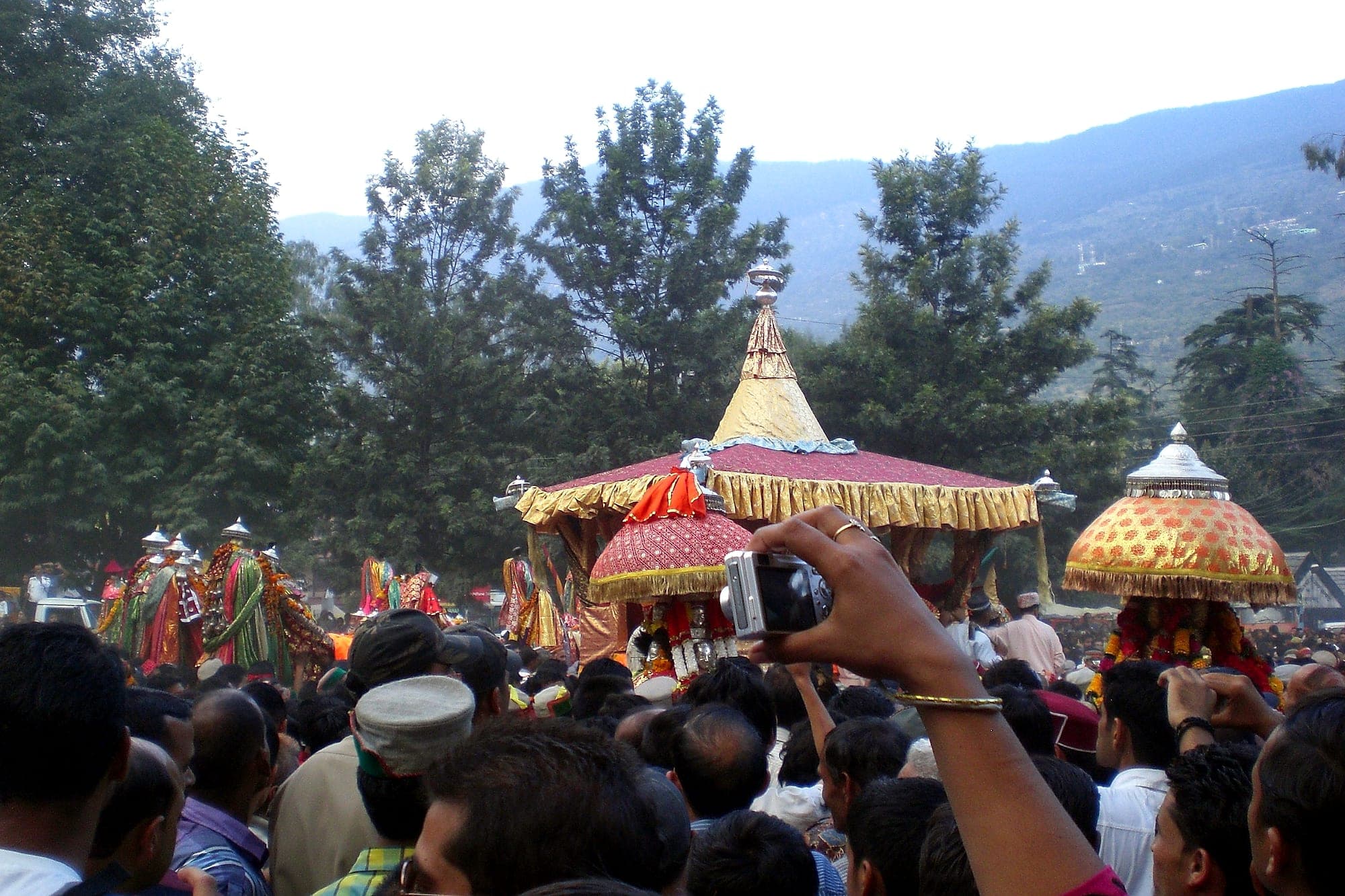
The festival's origins trace to the 17th century, when Raja Jagat Singh of Kullu is said to have installed an idol of Raghunath (Rama) as the presiding deity of the entire valley, after a legend involving the Raja's guilt over a wrongful act and a subsequent penance advised by a sage. From that point on, Raghunath's chariot procession became the valley's central Dussehra event — and over time, local devtas (village deities) from across the Kullu valley began joining the procession, carried down from their home temples on ornately decorated palanquins to pay respects to Raghunath.
What Happens
Upward of 200 local deities, each with their own palanquin, musicians, and village entourage, converge on Kullu's Dhalpur maidan — a genuinely unusual sight, since most of these devtas otherwise stay within their home villages year-round and rarely travel. The week includes processions, folk music, and a market fair, closing with the ritual burning of a small pile of grass symbolizing Lanka rather than a giant Ravana effigy, a deliberate departure from how Dussehra is marked almost everywhere else in India.
Quick Facts
- Begins on Vijayadashami (the day mainstream Dussehra ends), runs about a week
- Dhalpur maidan, Kullu town, Himachal Pradesh
- Raghunath (Rama), installed by Raja Jagat Singh in the 17th century
- Up to 200+ local village deities join the procession
- Included on UNESCO's Representative List of Intangible Cultural Heritage since 2010